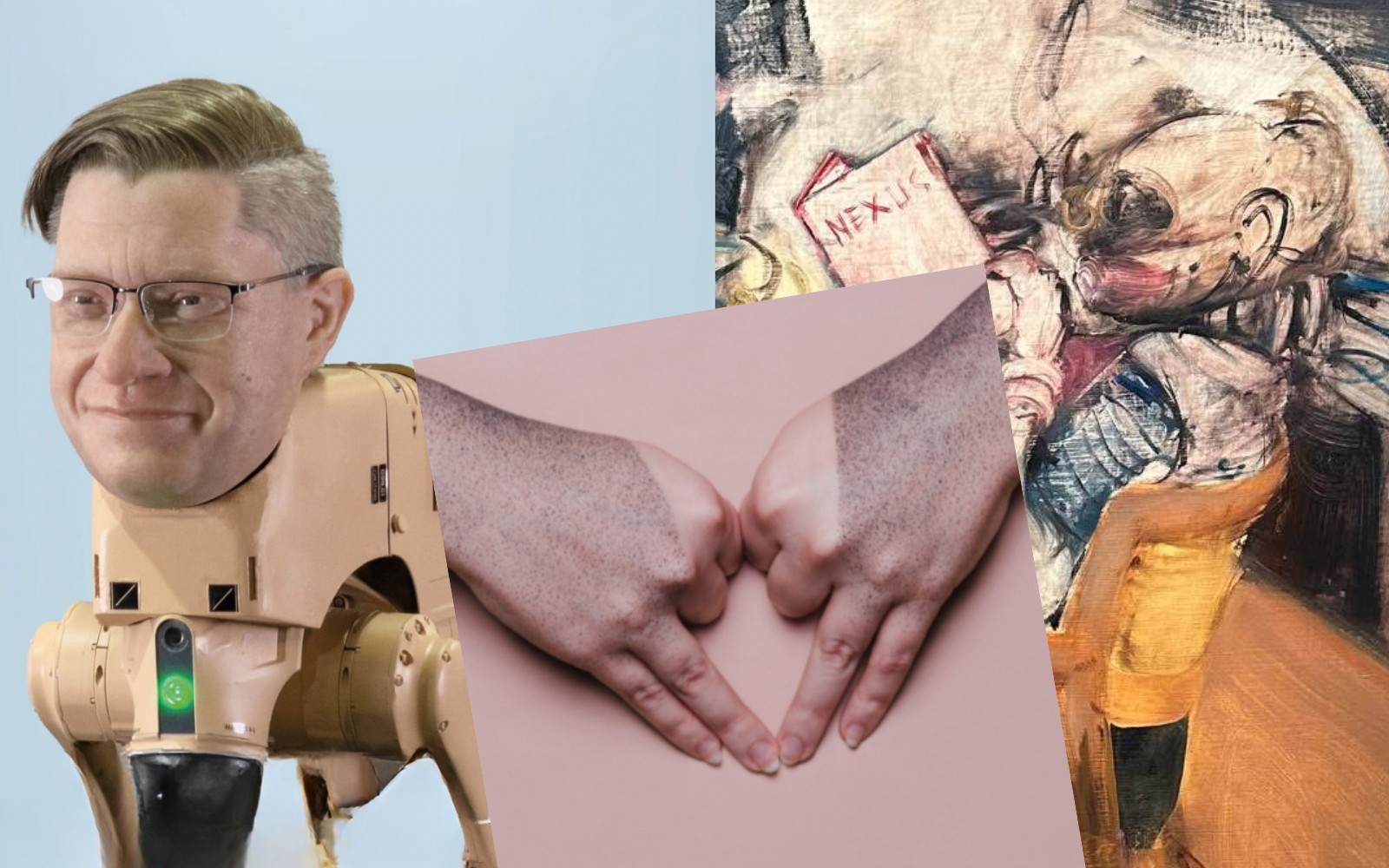
For a long time, tattooing tried to justify itself through permanence, rebellion, ritual, or identity. But something else has happened in the last decades, something far more important: tattooing has begun to develop its own visual consciousness.
Not simply styles. Not trends. A new way of thinking through the body.
Many artists still describe the “renaissance” of tattooing as something that happened in the 1990s. Technically, perhaps they are right. Tattooing became cleaner, more accepted, more ambitious. But what happened after that may prove far more significant. The medium slowly escaped illustration and entered something closer to visual language.
Artists such as Ksw Arrow reconstructed entire histories of painting directly onto the body. Dalí, Rothko, Courbet, Jacques-Louis David, impressionism, cinema, literature, mythology, animation. Not as copies alone, but as psychological migrations of images into living skin. The body became not only a surface, but a moving museum of references.
This process was necessary.
Tattooing had to exhaust the archive of external imagery before discovering its own voice.
And now, slowly, it is happening.
Artists like David Kodak no longer simply “place” images onto the body. Their interventions alter the perception of the body itself. The tattoo ceases to function as decoration and begins behaving more like installation art, spatial distortion, or living sculpture. The body becomes exhibition space. A site of continuous transformation.
At the same time, entirely new aesthetics emerge from digital culture itself. Cyber-sigilism is one example. Yet ironically, many of these highly repetitive linear systems may become the first tattoo styles easily executable by machines. A robotic arm could reproduce them with terrifying precision.
This raises an uncomfortable question:
If machines can replicate certain tattoo languages perfectly, what remains human in tattooing?
The answer may lie precisely in what cannot yet be automated:
intuition, psychological tension, symbolic ambiguity, emotional contradiction, the invisible relation between image and body.
Tattooing is approaching a threshold where it may no longer be understood purely as craft, nor purely as image-making. It may instead become part of a broader cultural mutation regarding how humanity understands the body itself.
For decades, society has argued endlessly over identity, race, sexuality, religion. Necessary discussions, perhaps. Yet many of these conflicts still operate within archaic understandings of the human body.
A much larger shift is approaching.
Not only technological revolution, but bodily revolution.
The world speaks constantly about artificial intelligence, robotics, synthetic life, neural systems, nanotechnology. Kurzweil predicted decades ago that humans and machines would eventually merge. Popular culture often imagines this grotesquely: metal implants, mechanical limbs, invasive interfaces.
But the real transformation may be subtler.
Less “machine inside the body.”
More:
the body becoming programmable space.
Not necessarily through violence or spectacle, but through culture itself.
Cosmetic surgery already normalized the idea that the body can be redesigned. Tattooing may become the next philosophical step: not correction of the body, but expansion of its symbolic capacity.
A tattoo is not merely pigment.
It is a decision about how consciousness occupies flesh.
This is why immersive environments matter. Why augmented reality matters. Why responsive monuments, AI archives, blockchain provenance, and digital tattoo collections are not disconnected experiments, but fragments of the same transformation.
Tattooing does not end at skin anymore.
The image now continues into networks, databases, virtual spaces, projections, archives, and machine-readable systems.
The body is becoming both biological and informational.
And perhaps this is why tattooing matters now more than ever.
Not because it is fashionable.
Not because it is rebellious.
Not because it is ancient.
But because tattooing may become one of the first art forms capable of negotiating the future relationship between image, identity, technology, and living matter.
The “renaissance” of the 1990s may ultimately be remembered not as the rebirth of tattooing, but merely as the moment tattooing first became conscious that it was evolving into something else entirely.